
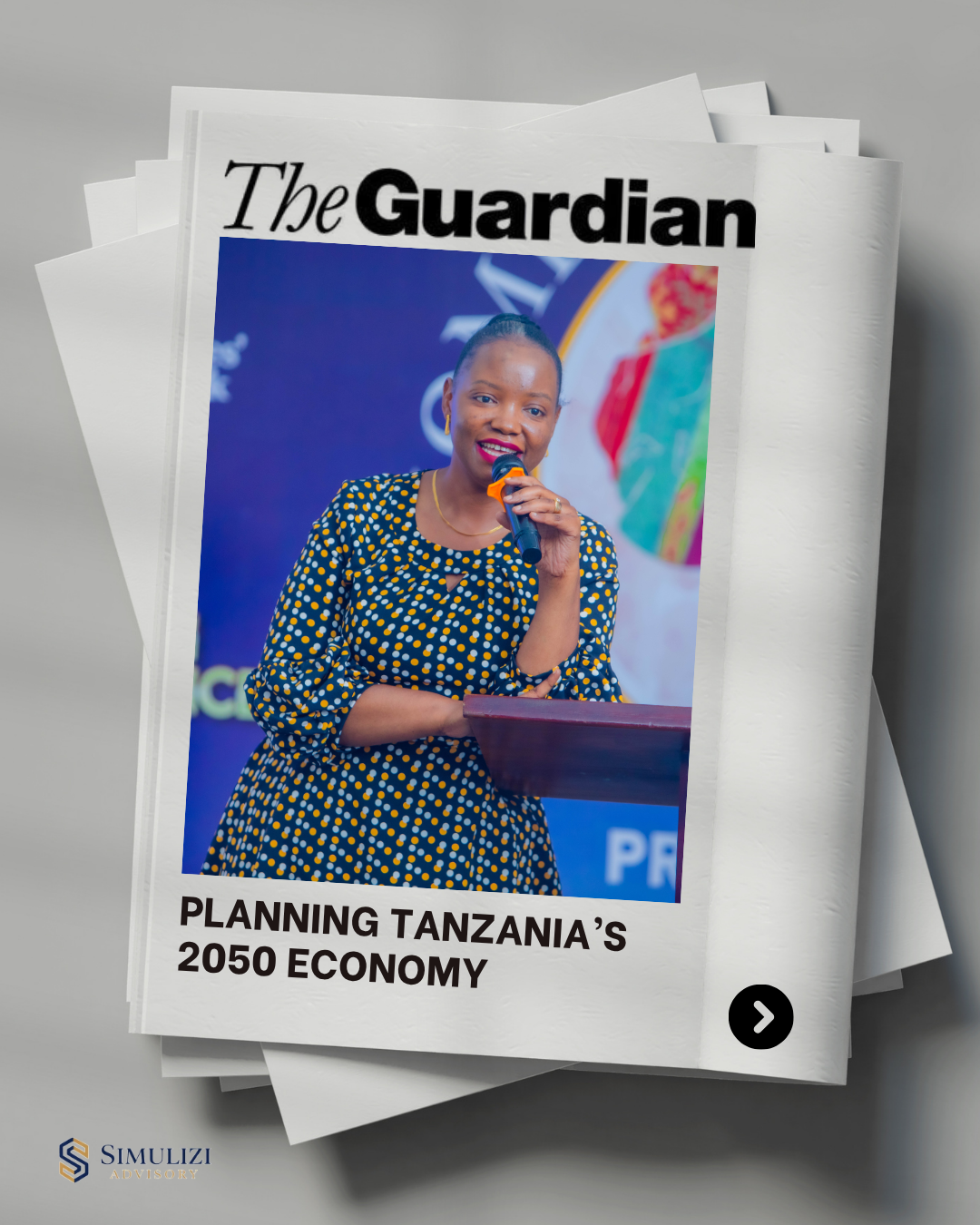
By Annastazia Rugaba
Every year, thousands of Tanzanian families make one of the biggest investments they will
ever make.
A son or daughter completes Form Six. There is celebration. Then comes the question:
Utasoma nini chuo?
A course is chosen. Fees are paid. Student loans are taken. Three or four years are
invested. Then comes graduation — and another question:
What exactly has this young Tanzanian been prepared to do in the economy Tanzania
is becoming?
That question is becoming urgent because Tanzania has already decided that its future
economy will look very different from the one we have today.
Under Development Vision 2050, Tanzania aspires to become an upper-middle-income
country with an economy approaching US$1 trillion, supported by industrialisation,
technology, research and development, digital transformation, modern infrastructure and a
much more productive private sector.
This is not simply about making today’s economy bigger.
It is about building a different economy.
And a different economy requires different capabilities.
Eight and a half million jobs — but doing what?
The Fourth Five-Year Development Plan (FYDP IV) makes the challenge immediate. It is
built around reforms for inclusive economic growth and employment creation and recognises
persistent skills mismatches between education outputs and labour-market needs. It
specifically identifies gaps affecting areas such as manufacturing, ICT, logistics and tourism.
This matters because millions of jobs cannot be treated simply as an employment statistic.
Every job represents a capability somebody must possess.
Who will operate increasingly automated factories?
Who will manage digitally enabled ports and logistics systems?
Who will undertake mineral processing and beneficiation rather than simply extracting raw
minerals?
Who will protect banks, hospitals and public institutions from cyber threats?
Who will deploy precision agriculture, analyse agricultural data and connect farmers to
sophisticated value chains?
Who will design, build and maintain renewable-energy systems, data centres and modern
transport infrastructure?
And who will do the jobs that do not yet have familiar titles in Tanzania today?
We often ask how many young people enter university and how many graduate.
The harder question is: what are they actually capable of doing when they leave?
More graduates are entering a labour market that is changing underneath them
Tanzania’s expansion of education is an achievement worth protecting. More young people
than ever have opportunities their parents and grandparents never had.
But expansion creates a new responsibility: relevance.
Technology is changing occupations faster than many education systems around the world
can redesign programmes.
Consider office administration. Typing, scheduling, filing, transcription, routine
correspondence and minute-taking can increasingly be supported or performed by digital
workflow systems and artificial intelligence.
That does not mean administration has disappeared.
It means the job has changed.
Tomorrow’s high-value administrative professional may need competencies in digital
workflow management, executive operations, project coordination, information governance,
data literacy, compliance and technology-enabled productivity.
Accounting has not disappeared either. But routine bookkeeping and reconciliation are
increasingly automated.
Marketing has not disappeared. But customer analytics, digital platforms, e-commerce and
AI are changing how it is practised.
Human-resource management has not disappeared. But payroll, recruitment screening,
employee records and workforce analytics are increasingly digital.
Records management has not disappeared. If anything, a digital state makes information
governance, data protection, electronic records and cybersecurity more important.
The issue, therefore, is not whether an old course title still exists.
It is whether what is being taught has changed as fast as the work itself.
There is another problem: curriculum relevance is not the same as labour demand
This distinction matters.
A university may completely modernise a programme and still produce more graduates in
that field than the economy can absorb.
Another programme may have strong labour demand but teach outdated competencies.
A third occupation may be growing rapidly, but the best preparation for it may not be a four-
year university degree at all. It could require a technical diploma, apprenticeship,
professional certification or a combination of these.
This is why the national conversation should move beyond simplistic lists of “courses with
jobs” and “courses without jobs.”
We need to understand skills demand, graduate supply and curriculum relevance
together.
Our own national planning documents already recognise this.
The Long-Term Perspective Plan calls for technical and vocational pathways to be aligned
with current and future labour-market demand. Importantly, it proposes a responsive
curriculum-review mechanism informed by industry needs and technological trends,
alongside stronger university-industry partnerships, internships, apprenticeships and
attention to graduate employability.
The diagnosis, therefore, is increasingly clear.
The challenge is execution.
Employment alone does not tell us enough
We should also be careful about how we measure success.
A young person being classified as “employed” does not necessarily tell us whether their
education is being productively used.
Someone can be working but earning very little.
A graduate can be working full-time in an occupation requiring only a fraction of their
training.
Another may have entered a survival activity because no alternative was available.
Another may have deliberately created a growing business employing ten people.
All four may appear in employment statistics. Economically, however, their outcomes are
very different.
This is particularly important in Tanzania because informality remains a defining
characteristic of our labour market. The Tanzania and Zanzibar Labour Market Profile
identifies the dominance of informal work and warns of structural challenges in generating
sufficient decent formal jobs, while also identifying skills mismatch as a significant labour-
market risk.
So the national question cannot simply be:
Did the graduate get a job?
We also need to ask:
What work did they get? Does it use their capabilities? What are they earning? Are
they progressing? Are they creating enterprises and jobs themselves?
We must also rethink our obsession with degrees
There is another conversation Tanzania needs to have.
A modern economy does not run on university graduates alone.
It needs researchers and engineers, certainly. But it also needs technologists, technicians,
electricians, welders, machine operators, laboratory specialists, digital specialists, artisans
and many other highly skilled professionals.
We need engineers — and excellent engineering technicians.
We need agricultural scientists — and technicians and farmers capable of operating
increasingly sophisticated agricultural technologies.
We need software engineers — and network, cloud and cybersecurity specialists.
We need architects — and skilled construction professionals capable of working with modern
building technologies.
The question should not be whether university education is better than technical education.
The question is whether Tanzania is building the right combination of capabilities at every
level of the economy.
Some occupations require four or more years at university.
Some require excellent technical education.
Some require apprenticeships.
Others increasingly require professional certification and continuous reskilling throughout a
career.
We should stop treating these pathways as a hierarchy of human worth.
And universities cannot solve this alone
It is easy to blame universities whenever employers complain that graduates are “not
employable.”
That is too simplistic.
Employers themselves have responsibilities.
If industries want work-ready graduates, they must participate more seriously in curriculum
development, provide internships and apprenticeships, open workplaces to practical learning
and communicate emerging skills needs before shortages become crises.
Government must create incentives and systems that make these relationships work.
Universities must continuously modernise programmes.
And lecturers themselves need opportunities to reskill. A curriculum can mention AI,
automation, data analytics or new industrial technologies on paper while the people teaching
it have had little exposure to those technologies in practice.
Curriculum reform without faculty development risks becoming cosmetic.
The biggest missing link may be data
Tanzania already has a great deal of information.
NBS produces labour-market statistics. Education institutions hold programme and graduate
records. Universities conduct tracer studies. Employers advertise vacancies. Government
systems hold information on businesses and formal employment.
But we still struggle to answer a simple chain of questions nationally:
What did a young Tanzanian study? How long after graduation did they find
meaningful work? What occupation did they enter? Does it relate to what they
studied? What do they earn? Did they create an enterprise? And where are they three
or five years later?
That missing feedback loop matters enormously.
Imagine a Form Six graduate in Mbeya, Mwanza or Mtwara being able to see credible
information before choosing a programme: occupations growing in their region, emerging
national skills shortages, graduate employment outcomes and the qualifications employers
actually seek.
Imagine universities seeing that employer demand for one skill is rising three years before
today’s students graduate.
Imagine policymakers seeing that one programme is producing far more graduates than the
labour market absorbs while another occupation faces persistent shortages.
Imagine investors being able to identify Tanzania’s human-capital gaps before making major
investments.
That is not merely education data.
It is economic infrastructure.
So what should Tanzania do?
We do not need a national panic about “useless degrees.”
Nor should we abolish humanities and social sciences simply because their economic value
is harder to measure through immediate vacancies. A serious country needs people who
understand institutions, society, language, history, ethics, communication, culture and power
just as it needs engineers and scientists.
But neither should any programme be protected indefinitely simply because we have always
taught it.
Every programme should periodically face evidence-based scrutiny:
Should it be retained as it is? Redesigned? Expanded? Merged with another programme?
Delivered through a different qualification? Or, where evidence consistently shows that it no
longer serves a meaningful economic, professional or public purpose, suspended?
And three things can make that possible.
First, Tanzania needs a stronger national system for tracking graduates from education into
employment, entrepreneurship and career progression.
Second, programme and curriculum reviews must become more responsive to labour-
market evidence, technology and the country’s long-term development priorities.
Third, young Tanzanians need credible career and labour-market information before they
choose programmes, not after they graduate.
The first builders of 2050 are already in our classrooms
Dira 2050 is sometimes discussed as though 2050 were far away.
It is not.
A child entering primary school today will be in the prime of their working life in 2050. A Form
Six graduate choosing a programme this year could still be working in the 2060s.
The people who will build Tanzania’s US$1 trillion economy are not an abstract future
generation.
Many of them are already sitting in our classrooms.
We can build railways, ports, industrial parks, power systems and data centres. But
ultimately, people must know how to operate them, improve them, govern them, connect
them to markets and turn them into productivity.
Human capability may therefore be the most important infrastructure Tanzania builds
between now and 2050.
The most expensive degree is not necessarily the one with the highest tuition fee.
It is the degree a young Tanzanian spends three or four years earning for an economy
that no longer needs what it taught.
If Tanzania is serious about the economy it wants to build by 2050, we must stop asking only
how many young people enter university and how many graduate.
We must start asking what they will be capable of building when they leave.
Annastazia Rugaba is Founder and Chief Strategist at Simulizi Advisory, Tanzania. She
works at the intersection of institutional transformation, strategic communication, public
policy and development strategy.